Writing and words

Happy Spring, Kelley!

Join me for a pint of Guinness, eh? No, not the stuff sold here in the U.S., but an actual draft from a pub in Ennis, Ireland, where we saw some local musicians jamming three years ago. Tastes better over there somehow.

So much to do, so much to say. I finally got Laura, my wife, to read Solitaire in December. As a schoolteacher, Laura is always too busy to read, but over her winter break, she asked me for a suggestion and your book was the first I put in her hands. I think she finished it in a day or two, couldn’t put it down. But I realized when she was done that the story and characters were no longer fresh enough in my mind to really talk with her about it. In the middle of the holiday season, I filed this away mentally for later review.

So here I am two months later, end of a gloomy February, and checking out VP and I follow your link to the web journals of Jackal and the others and I know it’s time. So I read it again, savoring the words and yet still gobbling them down in two days.

So this story is my usual long set-up for a couple of pints…er, points. First, kudos on a work that wears well. I read a lot, and re-read my favorites frequently. I love it when I continue to get more and more out of a book the more I read it. I’m already looking forward to the next go-round with Solitaire, when it’s time again.

I agree with the hesitation to try a sequel, and at the same time absolutely love the web journals and want more of them. The everyday nature of the journals makes the characters even more human and real to me without forcing them into an artificial plot as many sequels do. Because, in most cases, what I want from a sequel is more time with the people I’ve fallen for in the first installment, and artificial plots detract from that and can even make great characters less consistent and human. So –” love the web journals!

And (at long last) a question: when you’re writing, are you conscious of the words? I was struck during this reading of Solitaire by what seemed a very deliberate choice and positioning of words. I dimly recall a monologue from Tom Stoppard’s The Real Thing in which the playwright character compares good writing to a good cricket bat –” he debunks the idea that writing is merely the process of stringing words together in readable sentences, declaring that good writing is a craft which at its best is undetectable –” you can’t see the seams, but you can tell the difference when the ball hits the bat. Well, I’m not saying your seams are showing, merely that as a writer myself I can appreciate the crisp sound of the ball off a good bat as much as I can the resulting line drive to the wall. (Okay, was that three metaphors mixed in a single sentence, not to mention scrambling cricket with baseball? Hmmm… another sip of caffeine…)

Back to the point –” when you are writing, are you consciously crafting the structure at the same time as you are building the plot? Some writers write a draft straight through to get it down, then knock out the dents in rewrites. Some writers revise as they go — not recommended, but possible. Do you rewrite a great deal to make sure every word is properly placed, or do you place words deliberately as you go and tend to stay closer to an original draft?

Wow. Like Jackal, I’m tempted to delete this rambling post in favor of a simpler, less revealing howdy. But what would be the fun in that?

Thanks for the ear and the forum. Not to mention the now-empty glasses on the bar…

Keep passing the open windows,

Adam Diamond


Hey, Adam.

Isn’t it true about Guinness? We went to Dublin about four years ago, and I fell in love with everything about the place. Wonderful time, which included my first taste of Guinness (“The Guinness,” as the barman called it when he drew it for us….) There’s an Irish pub in our old neighborhood in Seattle that sometimes manages to make the Guinness taste like the memory of that trip, for which I’m grateful.

I’m glad Laura enjoyed Solitaire. I always feel an inordinate glee when Nicola likes a book I’ve recommended, since it often doesn’t work out that way. We dislike many of the same books, and we have a short but precious list of books that are treasures for us both, but there’s a vast middle ground that we just shake our heads across in fond bemusement. Then she curls up with treatises about the plague in the Middle Ages, and I go back to Stephen King and Carlos Castaneda (huh, Castaneda –” haven’t read him in a while. So there you go, that’s the next book that’s coming off the shelf).

I have begun updating the journals on a more regular basis, and am hoping to keep them more active. I’m feeling my way through questions like “how often” and “how much overlap,” and the balance between daily details and “plot.” There is some plot there, a story that’s slowly taking shape in my head. But I’m with you on the point being more time with the characters, as opposed to Great Big Fast-Moving Story. The more I work with the journal format, the more potential I see in it for really interesting forms of story –” multiple viewpoints, multiple points of entry for readers, and (at least for me) a sense that it’s more difficult for the writer (me) to force an agenda on the characters. And it’s an incredible chance to explore the accretion of small daily consistencies and changes that make a life and a person. So do please keep reading, if you haven’t been back in a while.

For those who may not have found all the links:

Jackal
Snow
Scully
Crichton
Estar
Zack the cat
Solitaire

As for writing and words, well…. big question. Short answer: the words have to be right before I can move on. This doesn’t mean that it’s perfect on the first draft (I so wish). But I can’t just write any damn sentence in order to get the plot down on paper. I’m constantly refining as I work. I find it hard to separate “plot” from “character” from “the writing” –” to me, it’s the choice of words that builds character and story. The right words are an integral part of the story, not a layer that I put on top of it like icing. If the sentences aren’t right, then they won’t build the right story.

Although I outline, there’s so much of the story that only emerges in the emotional and psychological connections that form the conscious and unconscious structure of the work. And most times, I don’t know what those are until I see them on paper. If a scene is right, on the writing level as well as the “plot” level, then the story becomes deeper.

In our essay in Bookmark Now, Nicola talks about the fact that expert writers can paper over the cracks in a flawed story, but unless the flaws are dealt with, the story won’t ring true. I think this is absolutely right. I have just recently tossed about 5,000 words of Hollow (the new book) because they weren’t right. They were really nice words, beautiful sentences, great scenes with lots of feelings-n’-stuff –” all my stock in trade –” but they weren’t right for the story. I was able to go back pretty quickly and find the weak point, and rebuild from there. I don’t think I would have been able to do that if I didn’t have essential confidence that the book up to that point was solid. And I only have the confidence when the words are basically right.

This kind of rewriting happens all the time for me. It’s a constant process of refining the words to polish the rhythms and resonances, to solidify the emotional through-line, to balance the interior and exterior worlds of the characters. For me, it’s the only way to discover the deeper levels of story that I’m sometimes not aware of when I develop an outline. My work is all about character, and humans manifest themselves through large and small reactions to the world, through feeling and action. These can be subtle things, and require attention to nuance: a certain precision, even in a first draft.

Some writers would think this means I “waste” a lot of words. I don’t see it that way. For me, building a work is a three-dimensional process, a weaving rather than a layering.

This is hard to articulate. It’s one of the deepest, most fundamental aspects of my writing. If I’m not making sense, or need to clarify, I hope you’ll let me know.

Windows open, weather is fine. Enjoy your summer.
Life/story

Hello!

Thank you for writing Solitaire, it’s a beautiful book. Having live journal pages for Solitaire characters is a great idea. I especially like the pages of Snow, Estar, and the cat (so cute). When did you think of the idea? Thanks.

Adrienne


I’m glad you like the book.

I thought of the idea for the journals last year when I discovered a Live Journal community that was a Harry Potter role-playing game. Each player was a character from the books. Each character had their own journal, and all the posts were collected together in the community journal. It was as if you were reading an ongoing report from various points of view of what was happening at Hogwarts. I thought it was a great idea, really creative, and then I thought, hmmm…. these folks are playing a game, creating a community story, but why not use this structure to create a different kind of fiction?

The beauty of the journal format is its flexibility. Journals are by their nature a mix of the daily and the Big Event. I’m hoping that I’ll be able to wander around more in the world, hang out with people in Solitaire when nothing in particular is happening, have extraneous conversations…. Then there’s the chance to get more into the heads of Snow, Scully, Crichton, and Estar, the layering of different points of view on the same events. I have lots of ideas. And of course, there will also be a story unfolding, because otherwise it just seems self-indulgent. So that’s a challenge for me –” a new kind of story, an accretion of daily details.

The cat sends his regards. He agrees that he is very cute (grin). You might be interested to know that Nicola channels the cat for these journals. It’s fun to have her come play in my world. This collaborating thing might become addictive….

Continuation

You said:

You ask about a sequel. Those who have expressed an opinion seem divided between wanting to know more about what happens, and being concerned that a sequel will be more disappointing than rewarding. That’s a legitimate concern–”sequels are hard. I’ve said several times here in the virtual pub that I’m not planning a sequel, and that’s still true. And yet I do think about Jackal and her people, and I am currently interested in exploring new ways of making story, new ways of staying connected with these characters that I love.

As I was reading this I thought that it isn’t really necessary to think of additions to your story as a sequel in my mind. In fact I prefer to think of any story that has the same characters and settings as a continuation of the world you’ve created.

So here’s a notion I’m playing with. I’d be interested in comments.

Yes, like that; just how are these people getting on in their lives after VC or any touch they’ve experienced through the process and/or people they know who are involved with such. I’d sure like to spend more time with the folks and in the world you made. And what is the fate of Solitaire, does it really work, can people really survive it and be better for it? It doesn’t seem to me like a story with an end, there seems to be lots of stories in there yet. (I hope).

Sly in Anchorage


Hey Sly, how are things in Anchorage?

I like your perspective. A sequel is a whole new story, another complete arc of the characters and events, and that’s not what I want. But continuing, looking at smaller everyday moments and building a slower, more gradual story… that appeals to me. One thing I like about this approach is that it anyone who has read Solitaire doesn’t have to do any catching up (and anyone who hasn’t read the book will probably just wonder what’s up with the funny dates..)

I hope there are lots of stories in there too.

I haven’t updated any of the journals since I posted them, but that’s due to lack of time, and also to a need to let them simmer for a bit. I’m just about ready to get back into them. Stick with me (smile) — there is definitely more to come.

Edited in 2009 to add: And they have waxed and waned, but are often in the back of my mind as an interesting way to make story. Still thinking…

Staying connected

My two cents—for whatever they are worth. I am a scientist, not a novelist! I really enjoyed Solitaire. It was refreshing to read a scifi novel with all the important elements covered. First, there was actually some science here, not the all-too-frequent drama-in-spaceship that could just as easily be drama-in-hotel or whatever. There was also a real plot with a beginning middle and end, and you succeeded admirably where few authors do — in development of a believable character.

This theme of an exceptional individual overcoming tragedy has also been used in a few other great scifi novels, including Dune, Slow River and Contact. What if any works influenced you, or are personal favorites?

In the end, the final “resolution” of Jackal’s personal dilemma was the creation of a web. I was curious about this, since you did not develop this concept as a central theme. Rather, you stressed the search for self and love — could you comment on this? Are you planning a sequel to this novel?

Anonymous


A huge apology to you for taking so long to respond to your question. Bad author. No cookie.

I’m pleased that as a scientist you aren’t rolling on the floor laughing your ass off over Solitaire (which I often refer to as “waving at science on the way past”). Some of the temporal lobe technology does exist, and of course virtual reality is moving so fast that it’s hard to keep up. But part of the reason I don’t think of myself as a science fiction writer is that I have so little intuitive understanding of science as an art, a discipline, and a world view. This is one way in which Nicola and I differ greatly, and it’s not at all unusual for me to respond to an observation of hers with, “That’s physics, right?” Why did I start out in speculative fiction? I don’t know. It’s a mystery.

Drama-in-spaceship science fiction is a nice phrase (made me smile). My next novel is not science fiction for precisely this reason — science just isn’t a key component of the story.

Everything I read influences me on some level (even if only on the level of Yikes, I don’t ever want to publish anything this bad). Part of my challenge is to filter the influence of other books and other writers through my own lens, so as to avoid directly imitating my betters. There are some things I’d love to write but am not sure I’ll ever be able to (I admire anyone who can write Epic Fantasy about Noble People without sounding like lukewarm Tolkien). I’m reluctant to name favorites (although I do have them) because I turn to particular books at different times for different reasons. Some books I love, and some I admire, and they aren’t always the same. But I will tell you that the three earliest “exceptional individual overcomes difficulty” books that grabbed me and still haven’t let go are The Wolves of Willoughby Chase by Joan Aiken, Rite of Passage by Alexei Panshin , and Emergence by David R. Palmer. I’m sure that psychologists and academics can amuse themselves to no end with this bit of information.

It’s true that the web is not an overt central theme of the story, but for me it rings through everything Jackal does. Her web is an essential part of her identity — her early decisions leading to the accident and VC are a direct result of her sense of responsibility to the web. In VC, she breaks herself in part by breaking her connection to the web. Then she returns to the ‘real’ world, and everything she does is (in my opinion) part of a larger quest to understand her identity as a self alone and a self connected. How should she connect now? To whom? Where is her balance? Can she be herself if other people constantly bump up against her emotionally? Can she be herself without it?

Identity fascinates me, as does the balance between self and other. I think that defining this balance is one of the most compelling, complex and fundamental decisions that each of us makes, one that ripples through our entire life in horizontal and vertical ways. By that I mean both along our span of days (the horizontal axis) and throughout our internal layers of psychology, emotion, behavior, response, values, fears, joys (the vertical). This is territory I want to explore as much as I can.

You ask about a sequel. Those who have expressed an opinion seem divided between wanting to know more about what happens, and being concerned that a sequel will be more disappointing than rewarding. That’s a legitimate concern — sequels are hard. I’ve said several times here in the virtual pub that I’m not planning a sequel, and that’s still true. And yet I do think about Jackal and her people, and I am currently interested in exploring new ways of making story, new ways of staying connected with these characters that I love.

So here’s a notion I’m playing with. I’d be interested in comments.

Multicultural writing

I was amazed at your answer to the last question. I knew that Solitaire is a multicultural book from the moment I read that it took place in Asia and that the protagonist’s surname was Segura , but I missed most of the racial inferences. Most writers use epithets when they have minority characters (which I dislike), and I’m glad that you don’t. Now –” after reading all the details of the characters’ ethnicities –” I think I’m going to go back through Solitaire and try to find the clues I must have missed. I knew that Jackal was Spanish, but I missed the Italian part (but now I realize Donatella is an Italian name). I knew Tiger was Asian from the way you described him and from his last name, although I thought he was Japanese or Southeast Asian. I must say, you’re open-minded for portraying an Asian male so sexually (and attractively). And I knew Snow was Scandinavian, also from the description.

I do have a few questions. How did you become so open-minded about things? Were you raised that way, or did you become more accepting over time?

Anyway, I hope your week is going well. Thanks again.

Sirene


I find it challenging to write multiculturally, and am not overly impressed by my own skills in this regard. I believe that most white writers can and should do better. When writers of a dominant culture start patting themselves on the back for getting a few non-dominant characters in the mix, it’s just a bit too close to straight married men who want the world to call them heroes because they routinely do 50% of the housework. No one would ever praise a woman for doing her 50% of the housework, or tell her husband that he must feel “so lucky that your wife helps out so much!” Same theory applies here. I should recognize in my work, as in all other parts of my life, that not everyone looks, feels, thinks, believes, behaves, dreams, fears, loves, or experiences their everyday world like me. Not because I’m a hero, just because it’s my 50% of this work. I appreciate your approval, and I’m not trying to imply that you shouldn’t like this aspect of my work (or me, grin)–”quite the contrary! But I don’t want to start falling in love with myself about it either.

Part of the challenge of writing multiculturally is my own hang-up as a writer: I dislike reading character descriptions that are so obviously only there to satisfy the “rule” that the reader has to know what everyone looks like. (“Oh, no,” she said, brushing her golden hair back from her forehead…) Ick. And we’ve talked before about white writers describing white characters in particular terms without any reference to skin color, while characters who are not white are described first and foremost as whatever sort of not-white they are. I don’t have enough experience with a spectrum of literature by African-American writers, or writers from other countries, to make the same generalization, although I’ve understood from my African-American friends and teachers that skin color is an important (although not always openly-discussed) differentiation in African-American culture. Maybe someone here knows more about this than I do?

Sometimes the kind of obvious description I mention above is necessary: sometimes the most important thing about a character is skin color (for example, in the movie Beverly Hills Cop, when Eddie Murphy walks into the redneck bar, the point is that it’s full of white people). But that’s context. If hanging a race/culture/ethnicity tag on someone isn’t right for the context, then it’s just a lazy choice.

But since physical character description is necessary sometimes, that’s where skill comes in. I wanted to make the point in Solitaire that not everyone was white, but I also didn’t want it to be a big deal (from Jackal’s perspective) that she lived in a diverse society. I thought some of my choices were pretty clumsy, and some were okay. And you caught one of my mistakes. Tiger is indeed supposed to be Chinese, but I couldn’t find a family name for him that I liked (character names are important to me, and I sometimes really struggle with them). So I plugged in “Amomato” and promised myself I’d come back and fix it…and never did. Oops (laughing). Maybe he was an orphan adopted by a forward-thinking Filipino family, or something.

Anyway, you probably didn’t miss that many clues, because there aren’t that many, because I was trying hard not to make too many lame choices (grin). And I’m still trying in the new book.

I don’t know how open-minded I am: like everything else, it depends. I’ve done a fair amount of work to overcome the effects of being raised in a racist culture, and I was blessed with parents who fought against racism in all kinds of ways during my childhood. They were civil rights activists in the 60’s, and were part of an “underground railroad” of sorts that helped Black activists get out of town (sometimes the country) when things were getting too hot. There were still race riots in the streets of Tampa in 1968 and 1969, the police force was actively and aggressively racist, and things were terribly hard for people who weren’t white.

In 1970, one of the leaders of a Black youth movement in Tampa was arrested on a marijuana charge. He and his wife, who was white, lived with us for a few months during their trial (five people in a 700-square foot house, with the two of them sleeping on the living room floor, so as you might imagine we all got to know each other better). He spoke several languages, and taught me to play chess, and let me figure out for myself whether what was happening to them was right or not.

I went with my parents to court during the trial, and watched the police officer at the courtroom door “search” my mother’s purse by dumping it out on the table, or the floor, every time she went in or out; all the Black women were searched this way, and no other white woman was. Our phone was tapped. Uniformed officers showed up at our house for no particular reason. We were followed by patrol cars and unmarked cars (I was even followed as I walked to school one day, dangerous 10-year-old that I was). It was a little taste of what Black and Hispanic folks in Tampa lived through every day in a thousand different ways. It sucks that it happened, and is still happening to people everywhere, everyday; and it also taught me that racism is real, which was a very good thing for me to learn. I remember going to boarding school and describing some of this to my peers, many of whom flatly asserted that I was lying, that those kinds of things couldn’t happen in America. Go figure.

Because I was an only child, I spent a lot of time in adult company. My parents rarely excluded me from adult events as long as I was respectful and didn’t act up. Our parties were full of people of all colors, all ages, poor and wealthy, people who drank and those who used drugs, gay and lesbian people as well as straight people. I met bikers, Viet Nam veterans, low-level Mafia soldiers, lawyers, priests, artists, people with illness or disability. There was a lot of difference in the room when I was growing up. Along with loving me unconditionally and making sure I got an education way above my class expectations, it is the most powerful thing my parents did for me. Those three things built my foundations in ways that I’m still only just figuring out.

And does this make me Wonder White Woman? Absolutely not. I still struggle with racist assumptions and fears. I find it frustrating and shaming, but there you go, this is where we live and this is what it does to all of us.

I am learning these lessons again, in different context, in my study of American Sign Language and Deaf culture: much of our learning centers on the assumptions that hearing people make about deaf people, and the ways that deaf people can be oppressed by those assumptions. As part of that study, last year we read a book called Uprooting Racism: How White People Can Work for Racial Justice, by Paul Kivel; I highly recommend it. It’s not a book that beats up white folks about individual racism; rather, it looks at how racism manifests in America’s legal, educational, social, economic and cultural systems, and how any of us can take individual steps to push back against the various ways that this oppression has been institutionalized. It’s about ways in which white people can become allies to people of color. Some of the students in my class wondered why we were reading a book on racism to learn more about the experience of deaf people in America; by the end, it was pretty clear.

Uprooting Racism put me strongly in mind of another excellent book that explores systemic oppression from a different perspective: How To Suppress Women’s Writing, by Joanna Russ. Both great books.

And I’m sorry as hell that there’s any need for them. Sometimes I wonder why we’re all so damn hard on each other all the time. Socialization, enculturation, the slow accretion of assumption that congeals into Truth About The World and Everyone In It…. and whether we embrace it or fight against it, it still happens. Creating a worldview is a human thing, it’s what we do and I wouldn’t change it. I just wonder why so many people feel that there can be only one?

Yeeks, if we were drinking real beer instead of virtual pints, no doubt people would be propping me up and making go-home noises about now. And so I will. Cheers.

Not just a white world

Hello Kelley,

I wanted to let you know that I have read your novel Solitaire and loved it. I also wanted to let you know that I never would have, if Nicola had not been so effusive in her praise of it…I absolutely had to purchase it and am thoroughly pleased that I did so…it was an EXCELLENT read! It was vivid, alive, intriguing, captivating. I loved the concept, the depiction of the characters, I loved the flow of dialogue, the description of all that was tangible and not…absolutely lovely.

I have a question though, and I hope you don’t think it narrow-minded; it is not meant that way at all, I am truly curious. And perhaps someone has already asked this question, forgive me if that is the case…but: In light of the fact that Hong Kong is, shall we say, a major background, in the story, are Jackal, Snow (who sounds stunning) and the other characters Asian? I ask this because I don’t wish to fall into the trap of assuming all characters, in any book, are Caucasian.

Thanks so much for this. 🙂

Ciao.

~Rebecca~


Well, neither do I (smile), which is why I tried not to make whiteness the default value in the book. I visualize Ko as a true multinational corporation, a mix of people of many backgrounds bound together by the corporate metaculture. I think if you look again, you’ll find that Jackal is half Italian and half Spanish; Turtle and Jane are Hispanic; Bear, Crichton and Khofi Andabe are Black (I think of Bear as Afro-Caribbean and Andabe as African, but there are no specific clues to that). Tiger and Chao are Chinese. Estar is her deliberately indefinable self. Snow is as purely Norwegian as someone growing up in Asia can be. Scully is pretty generic Anglo-mutt. Neill is Australian, although you’d never know it from the book.

It doesn’t seem narrow-minded to me to question whether a white writer has considered that not everyone (and especially not everyone of importance) in her story is white. Quite the opposite. I think it’s good to read beyond majority-culture assumptions (all characters are white, straight, middle-class, Christian, physically unlimited, etc. unless otherwise labeled to identify their “difference from the norm”). And it’s good to write beyond these assumptions. But it’s not enough for a writer to go through her manuscript and hang a race tag on everyone. How stupid it would be to write a paragraph in the opening of Solitaire about Jackal looking for her web, “a racially diverse group of peers with a variety of cultural perspectives,” or some such crap. Especially if hanging the race tag is all the writer does. Creating characters who are essentially mainstream white folks in terms of worldview, experience, cultural assumptions and behavior, and then painting their skin a different color, does nothing to recognize diversity. It’s just bad writing. It takes more work to make people actually different from one another, particular in ways that reflect something about where they came from as well as who they are individually.

I’m not completely happy with the job I did in Solitaire in this regard, but the errors are those of execution, not imagination. And one reason I chose Hong Kong as the background for Ko, and Al Iskandariyah ( Alexandria) as the seat of world government, is that the world is edging toward a rebalance of power, in my opinion. If the people of the world will get off our asses and do something to help Africa, and if China builds a few more cultural and long-term economic bridges with other nations, then I think in thirty years it’s not going to be only white western superpowers driving the global cultural and political agenda. I think that will be a very scary time for many white westerners.

I’m glad you enjoyed the book and were willing to take a chance on it. But honestly, what would you expect Nicola to say (grin)–””My sweetie wrote a book and it sucks, don’t buy it”?

Cheers.

Please, can I go there too?

I agree with your thoughts about both the good and the bad sides of brotherhood/ sisterhood, the good side being the comfort zone of being with people you don’t have to justify yourself to, the bad side being a bunker us-against-them mentality. I see the good side first hand in my work environment, we researchers being able to understand each other’s arguments without involved explanations and feeling that, as long as we do our work competently, the nerdish aspects of our personalities are mutually overlooked.

One of the strangest cases of the bad side I’ve experienced first hand is my brother (who lives in a rural area) having his Ford pickup vandalized because many of the locals, who are culturally homogenous, have formed gangs that get in fights and deface each other’s property over arguments about whether Ford or Chevy is the better brand of motor vehicle. Incredible… but true. I suppose that such stuff is part of human nature, and it seems that even the rapid cultural flux we’re exposed to is unlikely to erase it anytime soon.

But, back to your answer to the “question I did ask,” the one about whether you would continue writing in the SF/Fantasy genre. In a nutshell, it seems that your answer was no, unless one of those settings offered something that would support the characters’ journey in a way that wasn’t otherwise possible. That makes sense, and real-world literature can be wonderful; The Brothers Karamazov is one of my favorites. The Bridge Of San Luis Rey is another. But, I have to admit that when I’m in the mood for recreational reading, I do love fantasy novels that give me a cool place to wander around in, and that in general I tend more towards reading SF/Fantasy than mainstream. Now that I’ve read Solitaire I’ll be picking up anything else you write, whatever the genre; but, truth be told, it’s much less likely that I would have picked up Solitaire in the first place if I hadn’t come across it in the SF section of the bookstore. So, don’t forget the SF/Fantasy fans of the world when you’re choosing among the no doubt numerous potential plots swimming around in your head!

It seems that the last 10% of any project is the most difficult to see through, and I expect that when you get to that point, and the going requires 100% effort, you’re going to want to choose between your “Kansas Novel” and your “Mountain Novel” rather than carrying them both along. Has that point come yet? Since neither of them involve aliens attacking with laser guns, or unlikely heroes/heroines overthrowing a dark lord, I won’t cast a vote one way or another, but whatever your choice, best wishes on making good progress.

Anonymous


People get het up over the most amazing things. If I drove our humble but doughty Toyota into your brother’s neighborhood, do you suppose the Ford and Chevy tribes would band together against the invader? You’re right about human nature; people will take their kinship wherever they find it, or create it if necessary, which is where things can get a little scary sometimes (ritual vehicle-mutilation being just one possible outcome).

It’s true that brother/sisterhood offers a kind of experiential shorthand, which is how I interpret your description of working with your fellow researchers. There’s a lot to be said for not having to establish context every time you express an opinion or idea, and for having a bond that forgives everyone’s individual warts in service of the larger interest. I think that’s what a good team is (in sports, in business, in love, in family).

As for reading and writing, well, who knows where I’m going (she said, with a brave smile). Some of my longest-owned, best-loved books are sprawling fantasy, sf or horror novels. I still turn to them for comfort reads, but I find I’m not reading as much new work in the field(s) as I used to. I’m reading a bit more mainstream, a lot more mystery/thriller, and a great deal more nonfiction. I find much current mainstream fiction dissatisfying and am trying to pinpoint why, so I can avoid doing it myself. I dunno, maybe it’s just me, but I’d rather read Mary Renault or John D. MacDonald or Patrick O’Brian than Don DeLillo any day of the week. I have recently enjoyed Set This House In Order by Matt Ruff (great writing and an amazing metaphor system, just wow…), and Tropic of Night by Michael Gruber (twisty mystery). I need to expand my mainstream horizons: I’m not exposing myself to all that’s out there, partly because I get a little tired of wading through tens of thousands of clever words, wondering when the story is going to start. I’ve become suspicious and curmudgeonly (laughing)! Must improve.

Conversely, a lot of the current speculative fiction I’ve picked up is NBP—nothing but plot. I know there are exceptions, but I’m just not finding a lot of them right now. I hold my breath for new Le Guin, Robin McKinley, Patricia McKillip, Peter Straub, Stephen King (well, we’ll see what happens there—it would be a shame if he truly means to publish no more beyond the last books of the Dark Tower series). There would be other people on this list, but they’re dead. Part of what I like about all these folks is their ability to create worlds and people that I love spending time with: a confluence of character, dialogue, prose that is witty and graceful as opposed to arch or clunky (or arch and clunky, oh, the horror….), an interesting world experienced through people who feel and behave, as opposed to just do, do, do. And what I want, I am figuring out, is to write a mainstream novel that does what my favorite speculative fiction does—sucks me in, makes me feel, gives me adventure, and provokes in me the urgent wish to go there myself and be with those people for whatever they’re going to do next. I’m not Pomo-Irony Girl, and shop-and-fuck-between-mojitos novels are not my calling, so I sure hope there’s room for me in the pond.

There I go, not answering the question again. As it happens, right now I am focusing on the mountain novel. There are some structural and character problems with the Kansas book: I’m not bagging it, but I do need to let it cool for a bit so I can scrape the big layer of fat off the top (anyone who has ever cooked lamb shanks is with me in this moment, I know). Part of the problem with the Kansas book, I am realizing right this minute, is that it doesn’t do what I just said in the last paragraph that I want to do in a mainstream context. There’s no adventure, no Please, can I go there too? No sense of camaraderie with the protagonist. Well. Damn. There it is. I can see I’ll be waking up at 3:00 this morning with my brain already chewing on what needs to change.

I think the mountain book is already different in this regard, at least I hope so. As I envision it right now, it’s very much about community and interconnection in a way that the Kansas book (light bulb!) really isn’t. I said to Nicola a while back that although the story and people of the Kansas book aren’t like Solitaire, on some level it was starting to seem similar to me. And I don’t need to be writing the same book twice.

It’s tricky. The Kansas and mountain books are both about disconnection and reconnection, about rebirth, as is Solitaire. On some level, it’s likely that everything I’ve ever written can be said to spring from these roots, and I’m sure it will be possible to point at whatever I write next and say it’s just like the last one. But the Kansas book feels like Solitaire without as much emotional solidity, whereas the mountain book feels very much like the next thing to do.

Goodness me, what a week. Table-pounding essays and important fiction realizations. Thank you for this round, it’s been wonderfully useful as well as interesting. I will certainly enjoy my actual beer tonight, and feel as though I’ve deserved it (grin).

Cover me

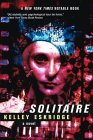
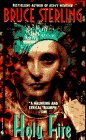
I walked into a barnes and nobles bookstore a few days ago and I was searching for a new book (even though I have a dozen at home that I haven’t read and another dozen on hold) when I found a book called Holy Fire by some other author, but it had the same cover as your book. Not the white one with the box and the face in it, but the face with the electronic stuff around it and the circle around the eye. I just wanted to let you know that there is another book out there that has stolen your book’s cover.

Alexander


No, really, it’s okay. Holy Fire is a novel by Bruce Sterling, a highly respected and accomplished writer, and was first published in 1997, long before Solitaire. The original artwork for the cover was created by a wonderful artist named Eric Dinyer. When it came time to create a new cover for the trade paperback of Solitaire, the publisher’s designer found this image and adjusted it for my cover. This happens a lot in publishing; it’s called recycling artwork, and it’s a way for the publisher to give a book a new “look” without the sometimes high cost of commissioning original art.

Bruce Sterling is aware that Solitaire used the same art as Holy Fire: he made a brief remark about it on this blog if you’re interested.

Ambivalence

I just finished reading Solitaire and am left with a few questions and conclusions.

I identified with Jackal in her search of “what am I and what am I suppose to do” in regards to being the “Hope”. I couldn’t figure out the big deal. But then, global and corporate domination isn’t something I would want to be associated with.

I saw her as a victim and a pawn, even at the end.

The elevator scenario was not her fault. She was doing her best, doing something when no one else was. And interestingly enough, I never thought she hit the wrong button, but instead the whole console was rigged by the terrorist. Nobody was going to get them out no matter what she or a technician did.

As I thought about the story, it dawned on me that the title of the book is ironic. Jackal was never by herself. Ever. Before prison it was Ko watching her, and during her sentence, the scientist/jailers were with her. Her implants kept her connected to the real world. No matter how much she thought she was alone or solo, she had to subconsciously understand that there were people always watching her. Interacting with her. Monitoring her every brain spike and functions. Her retreat to a unpopulated Ko showed she knew it would be the only way to be left by herself.

And now, she still isn’t alone. I never read where her implants and tracking devices were removed. She’s still not her own person. She’s still being controlled and observed, but just on her own terms.

Another puzzling part was her aversion to touch. Why would the lack of it for her imagined 8 years encourage her to pull away from it? It was mentioned at the end she recognized the last time someone had touched her, but yet, was uncomfortable with the one person whose touch she should have needed the most. Weird.

I enjoyed the “management “dialogs. It was interesting to see how things can be perceived with a corporate vision.

Thank you for a very thought provoking book.

Claudia


You’re welcome, although the book you read certainly wasn’t the book I meant to write. Not that it matters. I’ve been having an interesting discussion with a teacher about intentionality, and we agree that the writer’s intention isn’t the point of the reading experience. Still, I must say I’m sorry to hear that for you Jackal is a victim and a pawn throughout the book. I wouldn’t enjoy reading a book like that, and don’t much enjoy the thought that someone believes I’ve written one. But mileage varies, and it’s interesting to try to see the book from your point of view.

Very little of Solitaire is ironic, from my perspective (oh, here I go, talking about my intentions. Sorry. It’s hard not to, since I’m the writer as well as a reader in this case). Some long-term customers of the virtual pub may get a little tired of hearing me say this (oh well): I really do believe in hope, and small joys as well as great ones. I would wish the book to reflect that without irony.

Of course, Solitaire is also a novel that explores ambivalence on almost every level of the narrative, which is perhaps what has sparked some of your observations. It’s true for me that Jackal is still being observed, for example (her implants are there to stay), and controlled (she is still a convicted criminal with limited civil rights). And I also think she’s very much her own person, as much as any of us can be within the limitations that arise from living with other people in social structures.

There are so many folks in the world who never get to live on their own terms: it’s not an easy thing for me to categorize as “but just.” I think it’s a triumph: a small one perhaps, but a life of small triumphs is a successful life indeed.

The touch issue is another expression of the ambivalence that’s so much a part of the book. Not intentional (grin), but I can see how it fits into the larger pattern. Being literally untouched for an extended period of time can be a horribly isolating experience, especially if the body adjusts to it, and it becomes a physical norm. I think all humans have an individual baseline of touch (as we do with personal space, or tolerance of pain), and it’s my experience that if my baseline isn’t being met (because people are touching me too much, or not enough), I become uncomfortable. I think Jackal’s baseline changes pretty drastically in VC.

Touch is also part of the overall metaphor of connection in the book. Jackal identifies herself so strongly as connected (with Ko, the web, her family), and then she is so forcibly disconnected: her confusion about touch once she is out of VC is part of her overall confusion about reconnecting.

Hmm. That’s interesting to think about. Thanks for bringing it up.

I’m glad you enjoyed the management dialogs. I enjoyed writing them, and sometimes miss using my “business brain” on a daily basis as I did when I was in the corporate world. At the moment, I’m a member of a degree committee for a master’s candidate in organizational systems design, which is giving me the chance to share some of my knowledge and experience, and learn new things. Great fun. The corporate world isn’t the only arena where these skills are useful, but it’s one where having skill can make a huge difference to the quality of everyone’s daily experience. I’m biased, of course, but I wish more people cared enough about this stuff to instill it in their corporate cultures.

Cheers.

Send me an angel

I bought your book and I liked it, but I would like to get it signed and I wanted to know if you were going on tour. I couldn’t find any dates. I also wanted to know if you have another book coming out soon, or if your working on one. Oh yeah, and my favorite character is snow.

Alexander


No tour unless I pay for it myself, or find a tour angel who wants to jet me and my sweetie to places where people will turn up in droves, buy lots of books, and ply us with good food and wine and conversation…. ah, the writer’s life as it should be. I really enjoy doing readings and signings, and wish I had more opportunity. I think I’d do well on a tour –” I enjoy meeting readers, booksellers, reps and journalists, and there’s nothing like face-to-face mutual goodwill to help spread the word about the work. Anyone who can get me or Nicola on Fresh Air or All Things Considered, and would find a very nice dinner with us an incentive, please feel free to pull some strings on our behalf (grin).

I always post information about appearances in News, and will certainly give advance notice of anything outside of Seattle. Right now, the only way to get a book personally signed is to order one through University Books, and I’ll go in and sign it. (edited in 2008 to add: I’m not doing this right now, but you can email me directly and I’ll give you a PO Box to send a book to. Kludgy, I know, but there it is.) I know you’ve already bought the book, I’m not asking you to buy another, but perhaps someone will get you a signed copy for your next present-receiving occasion.

I like Snow too. It’s good to have a person of focus in one’s corner, as Jackal certainly knows.